Hello, this is the fourth I am David Brothers newsletter! I’m taking a vacation. I’m hoping to do a lot of figure drawing, practice with ink washes, finish a book a friend sent me (on paper!), and catch up on Tsutomu Nihei’s Tower Dungeon. Have you seen how he draws noses in that book? Like a vertical line and two periods? Unbelievable. Nihei is such a beast with a pen, and constantly evolving too. A dream. Anyway, here’s the newsletter:
—
Four things of no particular relation:
-Katsuyori Shibata update: Katsuyori Shibata held a position as trainer at NJPW’s LA Dojo for some time, and trained some of the most interesting wrestlers in recent memory, for my money at least. Alex Coughlin was one of those guys. An injury took him out of the industry and into retirement, but not long ago, he gave one of my favorite pre-match promos. It’s around an hour and twenty-eight minutes into the press conference for G1 Climax 33 (linked to the time), and he lays out his whole story in such an engaging and sad way that I instantly became a lifer. He’s that dude. A little before that, Coughlin and Shibata met in the ring, student and teacher, as part of Shibata’s run as Ring of Honor’s PURE Champ. Revisiting the highlight reel is a good time, from the story they’re telling together to the individual feats they both pull off. Coughlin is much missed, a beast that could’ve become anyone and anything if not for injury.
-More Shibata: The thing about this kind of encounter between the two of them is that it’s a story I love a lot. It’s not good or evil, right vs wrong. It’s “I need to beat you to move past you” and “I need you to hit me harder than that,” with a light topping of a teacher giving his student a platform to excel. There’s a moment where Coughlin is giving Shibata a series of chops in the corner, and Shibata growls his way out of the corner, demanding one more good one.
-One More Good One: Whenever I play games with the homies, we usually end on “one more good one.” It’s so that our last game of Apex Legends isn’t a three-minute drop and loot session before getting annihilated. We don’t necessarily need a win, but we do need to feel a little effort. Competition is nice. It’s very satisfying when it hits. (We do want a win, though. Unload your guns when you see us.)
-Death Stranding update: a few sections down is around a thousand words, give or take, about the way music is deployed in Death Stranding and Death Stranding 2: On the Beach. It’s spoiler-free, in that I don’t mention any characters or plot and am mostly just talking about walking around in a game, listening to music, and having some type of reaction. Please look forward to it.
—
I see where you’re coming from, Brain, I disagree:
The way my particular brain chemistry works is that in a year where I saw beautiful friends, took my teen siblings to their first concert, and had four books come out, my main impression of 2025 was that it was a long, lonely year. This runs counter to how I feel about my relationships, family, and life, if you’ve ever heard me talk about that stuff. Life is good. I’m doing things. My brain just happens to vehemently disagree with my self on occasion, and drags us both into the mud.
But life is good. I am surrounded by art and artists. I am loved. There are a functionally infinite number of books for me to read before I die. Writing feels amazing. Lots of things are bad, but lots of things are good, too.
I’m working on it.
—
$hort Dog, that’s Oakland, baby:
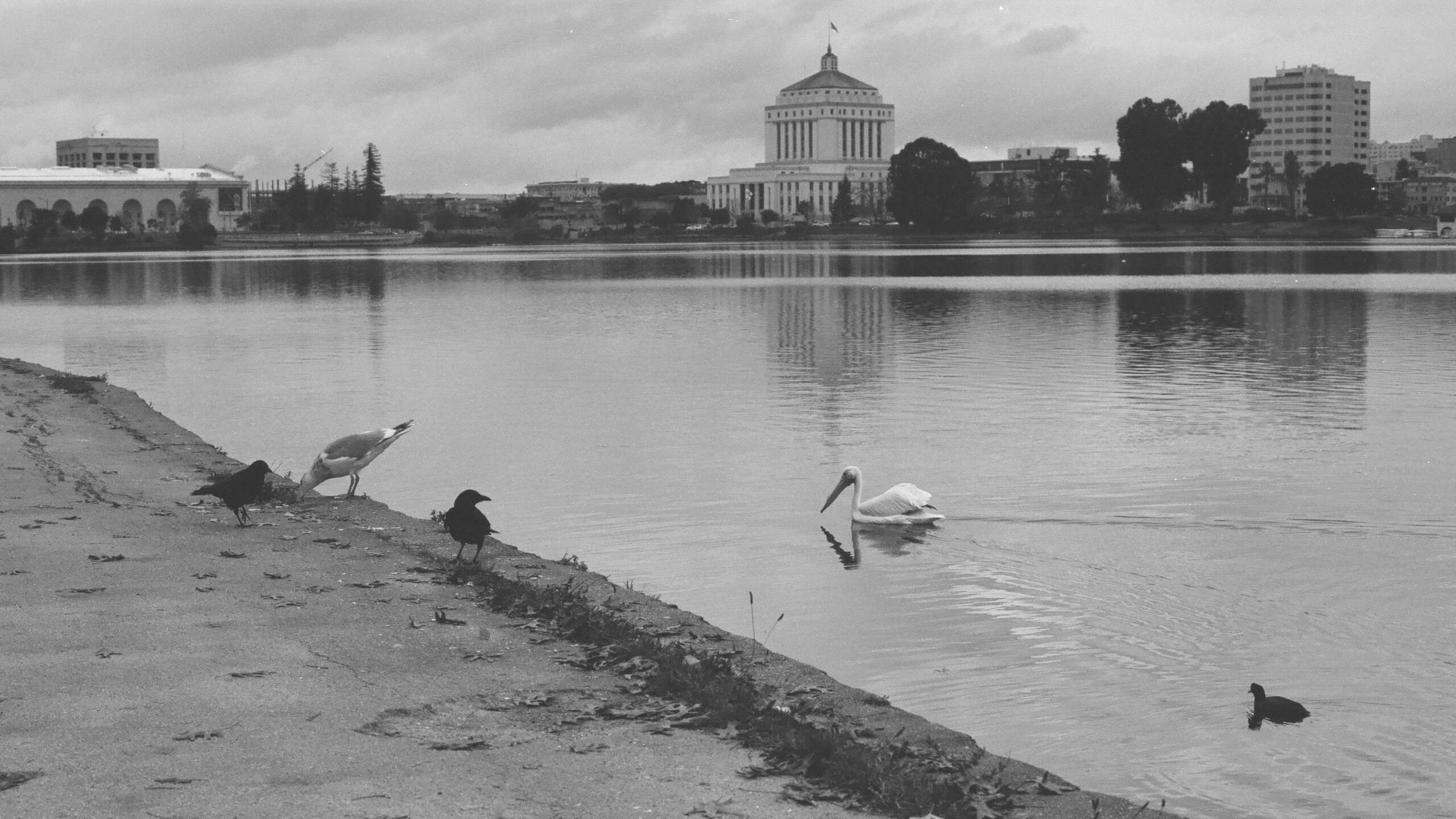
Here’s a picture of some birds in Oakland that I took before Christmas. I love living near Lake Merritt.
—
By the way, those four books are:
–Time Waits, drawn by Marcus To & Marvin Sianipar, colored by Matt Wilson, lettered by Ariana Maher, and written by me and Chip Zdarsky. Chip is currently also writing Captain America despite secretly being Canadian!
–Good Devils: Don’t Play Fair With Evil, created by Nick Dragotta and I over the course of a few years. Nick, of course, is tearing it up on Absolute Batman. Tegan O’Neil gave us a great review. I’ve been reading her forever.
–Perfect Crime Party, an anthology project featuring a short comic about a young criminal who is haunted by her father (in a shonen manga kinda way) by Alissa Sallah and myself.
–All-Negro Comics, edited by Chris Robinson. I have an essay in here, and I love this project so much. FUBU pre-FUBU, you know what it is, especially if you’ve seen the prior newsletters.
I feel really grateful that I’ve gotten to do comics with friends, starting with Apollo KIDz with Caleb Goellner (of Teenage Mutant Ninja Turtles x Naruto, which is wild!) up through now. This is what I mean when I say that life is good. I’d like to do more.
—
Breaking wrestling news:
I’m watching Pro Wrestling NOAH’s The New Year 2026 event on Wrestle Universe (the best wrestling app for the subscription price) while I write this to see what my beloved KENTA is up to lately. His new faction is called White Raven Squad, with a roster of the man himself, Tetsuya Endo, Ulka Sasaki, and HAYATA. They’re wrestling against Team NOAH, a team which does not feature KENTA and is therefore not as good as any team that features the Black Sun KENTA.
Look forward to me saying hyperbolic and borderline untrue things about WRS in the future. They’re a team of hard hitters and MMA maniacs, which feels like a perfect fit for NOAH, and leading a group is a nice evolution for modern-era KENTA. Honestly, they’re the best crew since Takeover, right? nWo can’t compete, DX can’t compete…who better?
—
More NOAH The New Year quick reactions:
-The Good Brothers? I disagree.
-Tetsuya Naito in a NOAH ring is something else. The crowd cheering hard really made me smile. “Kirby is here!” vibes. I hope this works out for the Ark. Naito is in rough shape but still a star, and it would be nice to see this go to really interesting places considering the weight of his legacy.
—
Writing about writing before you can read the writing:
Death Stranding 2 was a hard game to crack, writing-wise. I knew from the general thrust of the game that I’d have some kind of emotional reaction to write my way through, but (speaking generally) the game was aimed at its target in such a way that I took a full-spectrum lesson from it, not necessarily one thing I could narrow down into one essay. It gave me a lot to digest, which is the beautiful thing about art and something I’ve chased my whole adult life.
I’m less interested in talking about how weird and out-there Hideo Kojima and team’s writing is, in part because I don’t think it’s an entirely fair assessment when compared to other stories. However, I am very interested in talking about how those same things that feel out-there and weird meshes with the emotional resonance and storytelling techniques at play in the games. Basically, I think they’re normal. What’s a weirder name, Duke Nukem or Solid Snake? You know what I mean? I’ll probably come back to this with a real argument in the future.
Anyway, Death Stranding and Death Stranding 2 are about a lot of things, with an exploration of human connection being the fundamental core that everything else radiates out from, and I wrote myself into understanding what I wanted to say. I found my way into talking about the second game by talking about the music in both games. In the first essay, below, I approached the music in a general sense. I focused on the needle drops as you approach new areas, which isn’t particularly spoiler-y or relevant to the plot. Then, in the second essay, coming later, I found my self digging into the soundtrack to a scene that made me cry (essay two, coming soon). That gave me the experience and perspective I needed to do a longer third essay about the greater themes of the game and series and how it made me feel.
My little Death Stranding 2 essay cluster. They’re all written and intended to run here, but I’m going to space them out to avoid spoiling a few friends who haven’t made their way through the game yet. I’m figuring the game out, not to solve it, but to understand it for my self, and the best tool in my arsenal for doing that is trying to write about it and seeing where that goes.
This is what I mean when I say writing is like breathing to me. I need to do it.
—
On Death Stranding: it’s hard to fall believing
(Please listen to this Death Stranding playlist while you read this. There’s a lot of nice tunes from Low Roar and other bands.)
The Death Stranding series has a fascinating and cinematic approach to integrating music into the games. After a more traditional developer-controlled musical experience in Death Stranding, Death Stranding 2: On the Beach introduces a much-desired menu-based music player, allowing instant access to the songs featured in the game as the player, Sam Porter Bridges, wanders around the landscape. Players can also assign songs to the customized structures that dot the landscape, bursts of music that ring out as you pass by while carrying deliveries. My favorite feature of both Death Stranding and Death Stranding 2 is how game director/music producer Hideo Kojima uses the soundtrack to create a pleasant moment at the end of certain missions or episodes. It provides a sense of grandeur and adds a little juice to a moment that would otherwise be remembered as Yet Another S-Rank Delivery.
Speaking generally, the average Death Stranding 2 gameplay loop involves going somewhere to meet someone new, connecting them to a network, and then taking packages from them to a new location off-network, with the intention of connecting the person at the new destination and then continuing on to the next. When you’re inside the chiral network, you can build high-tech roads and structures to help support your deliveries, in addition to taking advantage of battery chargers or other valuable utilities. A wonderful endgame experience in either game is zip-lining around a mountain range that previously felt impassable, an awkward number of boxes carefully balanced in Sam’s carrier. It reminds me of riding a bike downhill in the summer, when movement itself feels like the most important thing in the world.
Outside the chiral network, players are on their own. There are ladders, ropes, and climbing equipment to help Sam get around, and players do have some access to some battery-operated technology that can help carry packages. Once the battery runs out or players run into an area haunted by BTs, the supernatural obstacles of the game, things get a lot more tough in a hurry. Maybe the right choice is to leave a package behind and to prioritize delivering the more important ones. Maybe the move is to stash a fully loaded backpack out of sight and provoke a fight with the monsters or humans from a position of strength, then work your way back to your hiding spot later. Either way, something has to be done and you have to do it.
Expanding the chiral network requires reaching a new city or compound. While making deliveries, Sam must endure long treks through hyper-aging timefall rain, ghostly BTs that have breached into our world of the living, and the homicidal/suicidal terrorists Homo Demens. Upon reaching the beginning of the final leg of the current journey, the soundtrack triggers and a predetermined song begins to play. The song accompanies the player as they finish the delivery, eventually fading as the song or the moment reaches completion. Once the person has accepted the delivery and consented to joining the chiral network, the songs are then unlocked for the music player in the menu.
The majority of my history with music and video games is less about specific, engineered experiences like these, and more about music that was present while gameplay was happening at the same time. Does that distinction come across? Both approaches to music enhance the gameplay experience, but the execution and effects are different for me.
The boss theme “Scream” from Final Fantasy XIV, part of the Pandaemonium raid series, is a personal favorite. I rarely grind in games, but I did grind just to get a reward that let me play that song whenever I’d like. But I don’t love it because of the sense of accomplishment I felt beating thee raids, and eventually learning them well enough to heal other players instead of playing a purely damage-dealing role. I love it because the chorus is a banger and super easy to sing along to. The song helped make playing those stages over and over a delight instead of a slog. I feel similarly about Yoshimitsu’s theme from Tekken Tag Tournament (I made it my menu music in Tekken 8), or “This Is True Love Making” from Capcom vs SNK 2 (here’s a sick cover). These songs were there for really fun times in my life, and represent a kind of exuberance or excitement in my head. It’s a combination of a good song and good gameplay, but the song doesn’t quite feel like part of the gameplay.
The way the soundtrack is used in Death Stranding 2 has elements of that approach, in that you can listen to whatever you want whenever you desire, but that first hit of a new tune is almost always paired with a traversal experience. The storytelling is zeroing in on the feelings that come when the player crests a hill and sees the goal in the distance. The city may still be a mile or two away, but the way is clear from here to there, and this new tune provides the perfect walking around music as you find your way.
As a result, when I hear those songs again in other contexts—in real life, in the game, whatever—my first thought is often the warm feeling of accomplishment and a beautiful vista, rather than a pleasant blur of trial and error gameplay. It doubles the impact of those songs, weaving a burst of surprise or satisfaction into my memory of the song.
I spoke to my younger brother for a video about Death Stranding earlier this year, a conversation about where his and my interest in games intersects. He mentioned that hearing “Asylum for the Feeling” featuring Leila Adu by Silent Poets in episode two of Death Stranding felt like the natural end of the episode. There was still more to do, but the hard part was over.
His reaction makes me think that it serves as a kind of victory music, a sign that I’ve done whatever it is I set out to do. I really appreciate the fact that my brother having a similar feeling means that it probably wasn’t just me reading too deeply into the work. There’s something happening here that we’re responding to, despite the twenty-some years between us.
This style of needle drop is a remarkably effective technique, and my approach to the gameplay evolved as I began to look forward to those moments. Rather than rushing to the destination and dropping off my packages to get on to the next mission and make a series of numbers go up, the reward music compelled me to slow down, to take in the sights, to try to time my arrival at the city with the climax of the song.
The music made me want to find a way for my gameplay to better intersect with the art of the musicians, which was in turn intersecting with the art of the developers. All of which created an artistic experience in my head that was and remains unique to me, but is still shared on a certain level by millions of others. None of us took the exact same path, and it’s possible to miss the song queue entirely by taking a circuitous enough route, but the intention on the part of the developers is that we still share that strong connection between song and sense of accomplishment.
I want to savor the music in the Death Stranding games. I love a lot of the songs individually, but there’s nothing like that moment when a song triggers and takes a simple delivery from a mission to an experience. It feels like exhaling.
—
If things are getting worse, then it’s good to help someone:
It’s still winter and it’s still cold. Do you have a food bank nearby? A shelter, something like that? They’re taking donations and orgs like this can be an easy way to help someone who needs it. Depending on where you live, there may be groups that aren’t non-profits helping too, if that’s more your bag. There’s someone helping, and if there’s not, maybe you and a friend or two can do something nice for someone else. Good things really only happen when we make them happen.
—
Rólate otro, carnal:
A friend of mine has been putting me onto some real tunes lately. I’d seen him and another friend talking about Health, an industrial noise/rock band, and thought it sounded interesting. I listened to their album Conflict DLC and “Trash Decade” made me feel like I got jumped on the first listen, and then “Don’t Kill Yourself” came around and sucker punched me as I was getting to my feet.
I’m a hip-hop guy to the core of me, but I’ve flirted with industrial over the years. I remember being a kid and playing Command & Conquer: Red Alert for the first time, still an all-time fave, and listening to “Hell March” as much as I could. My go-to is that I like songs that sound evil at first glance, and Health more than fits the bill. When they hit “I don’t wanna kill myself, but I don’t wanna live this way” on “Don’t Kill Yourself”? Whew, doggy. Yeah, that’s music, baby.
I like songs that are less evil and more of an overall good vibe too. Grupo RYE are a group of Mexican-American cats from Atlanta who specialize in mariachi. When I say they’re from Atlanta, I mean that they’re “shot a music video for their song ‘Carnal’ at Magic City” from Atlanta. They were chanting “ATL HO!” at a performance in Ibiza. Personally, I’m not from Atlanta, more from the country a bit further south than that, but these dudes are my people.
—
Further reading:
I don’t know how to write about music and video games. Before writing about Death Stranding 2, I asked some folks on bsky for nice essays about music and games. Cartoonist Gale Galligan shared these two, which are doozies. Great reads, the Untitled Goose Game one especially.
–Untitled Goose Game and the Magic of Reactive Soundtracks
I can’t personally write this way, but what at thrill to read it. The expertise and perspectives are delivered so well here.
—
Happy new year.
—
That’s it.
Happy new year to you too, David